
🍿 Popcorn: The Surface Pleasures
The film opens with the sound of twinkling magic, the kind usually reserved for a Disney logo. It cues fairytale over horror. Without any foreknowledge of how this version reworks Bram Stoker’s novel, that tonal repositioning may come as a surprise. Then the title clarifies the intention, Dracula: A Love Tale.
From the outset, this feels less like gothic terror and more like a romantic remix, somewhere between Dracula Untold and 1992’s Bram Stoker’s Dracula. The question becomes not whether this is a love story, but what kind of love it intends to sanctify.
Set first in 1480, Prince Vlad (Caleb Landry Jones) is introduced in the midst of intimacy with his wife, Elisabeta (Zoë Bleu). Love is depicted expansively: playfulness, shared meals, teasing, teaching, sex. This is not an abstract devotion but a lived one.
But battle calls. Vlad must leave. For he is not only a husband and prince. He is the Impaler.
Before departing, he visits his spiritual advisor and delivers a warning meant for God himself: If she dies, so do I. The armor he dons is ornate and monstrous—clawed gloves, horned mask—but the protection he seeks is metaphysical. God gave him life. God gave him love. And if love is taken, life cannot remain.
🛡️ Armor, Ultimatum & the First Break with God
The film resists prolonged battle sequences. Instead, it cuts swiftly to snow-soaked forests, Vlad defending, Elisabeta fleeing. Her escape on horseback through a white field seeded with hidden traps becomes a striking metaphor for life itself: graceful motion laced with threat.
Elisabeta dies. Vlad returns to his advisor, not to pray but to proclaim. He renounces God and places a curse on himself as retaliation. Damned.
As any man might, he struggles from the start with the governing narrative truth: never love the blessing more than the God who gave it.
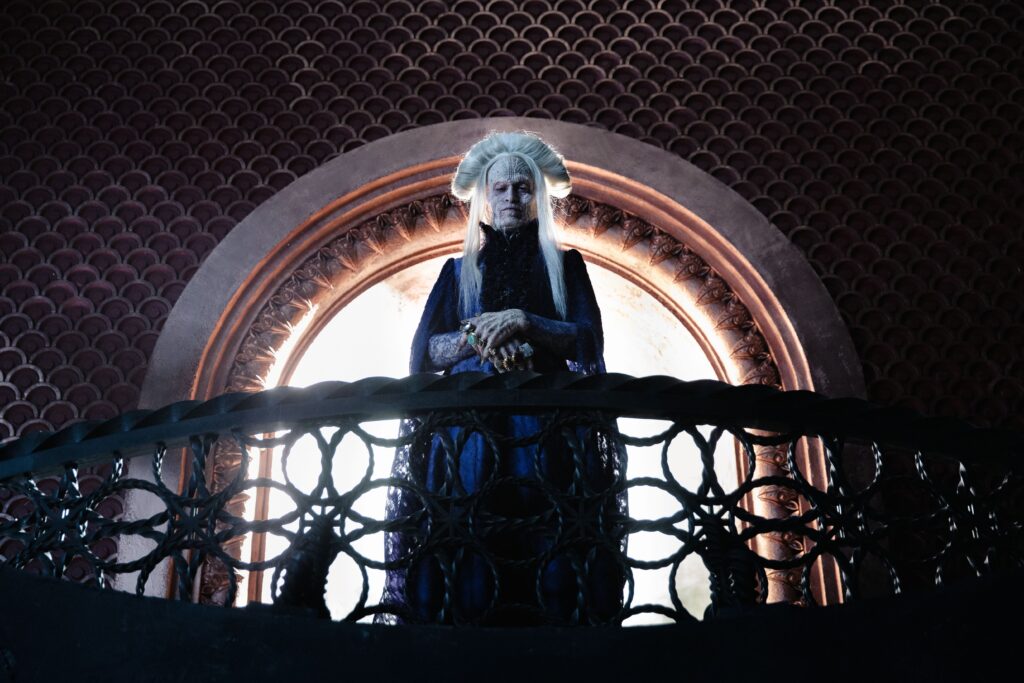
Four hundred years pass. Vlad has morphed into Dracul. His power, bloodlust and reputation precede him. Then Jonathan Harker arrives at the castle as his guest. After dinner, there’s an incident and he narrowly avoids death by asking, as a final wish, to hear Dracula’s story. Dracula agrees and recounts centuries of hope deferred, waiting for Elisabeta’s return.
What follows is a procession of excess: debauchery, blood, the creation of undead minions and finally the development of a potion meant to draw Elisabeta back to him.
🔥 Pyres: The Fire Beneath
Everything shifts when Harker attempts to bargain for his life by speaking of his own beloved, Mina. In her, Dracula recognizes Elisabeta reborn. For this revelation, Harker is spared and Dracula leaves at once.
To be alluring, youth is required. To reclaim it, Dracula enters a convent. This sequence becomes the film’s thematic centerpiece– faith versus disbelief. Love as salvation versus desire as damnation. A charmed life weighed against a peaceful afterlife. The result is a ballet of bloodlust, a grotesque pile of male convolution built upon feminine purity.
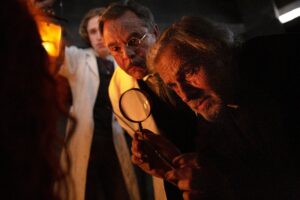
From here, the story fractures into pursuit. Dracula races toward Mina. Behind him come a Priest (Christoph Waltz) and a Doctor (Guillaume de Tonquédec) from the asylum where one of Dracula’s minions, Maria, has been imprisoned.
Priest is a departure from archetype. He is humane, measured and largely unafraid. As shown in the trailer, he does not seek to kill Dracula but to save him. Much of the film’s unexpected humor comes from him, softening the usual moral absolutism.
🍷 Appetite, Faith & the Hunger to Believe
A word is repeated throughout the film: appetite.
Not simply the vampire’s. That would be too easy. Each of them has an appetite, something they are salivating for and that needs to be satisfied. At one point, Priest pricks the finger of a boy, Clerk Simon (Raphael Luce) who works for the doctor, so his blood can be dripped into Maria’s mouth in exchange for information. For this, Priest promises him he’ll “buy him a bowl of lentil soup. He’ll be a new man.” The same Priest reminds the doctor that “appetite can be a sign of very good health.”
In this way, they are all equal in their quest for faith and love. All except Jonathan Harker (Ewens Abid).
Harker is an atheist. He believes in nothing. He is worse than Dracul, a man who lost his faith in God, a God he continues to believe in. In a tale where everyone is roped in the tug-o-war between faith and knowing, Harker is not just a misfit but a villain.
🍿🔥 Popcorn + Pyres Judgment
Mina and Dracula reunite. They are no longer princess and prince. It must be counted the ways he has become and at the same time come undone. He has been taunted and tormented. He is taunting and tormenting.
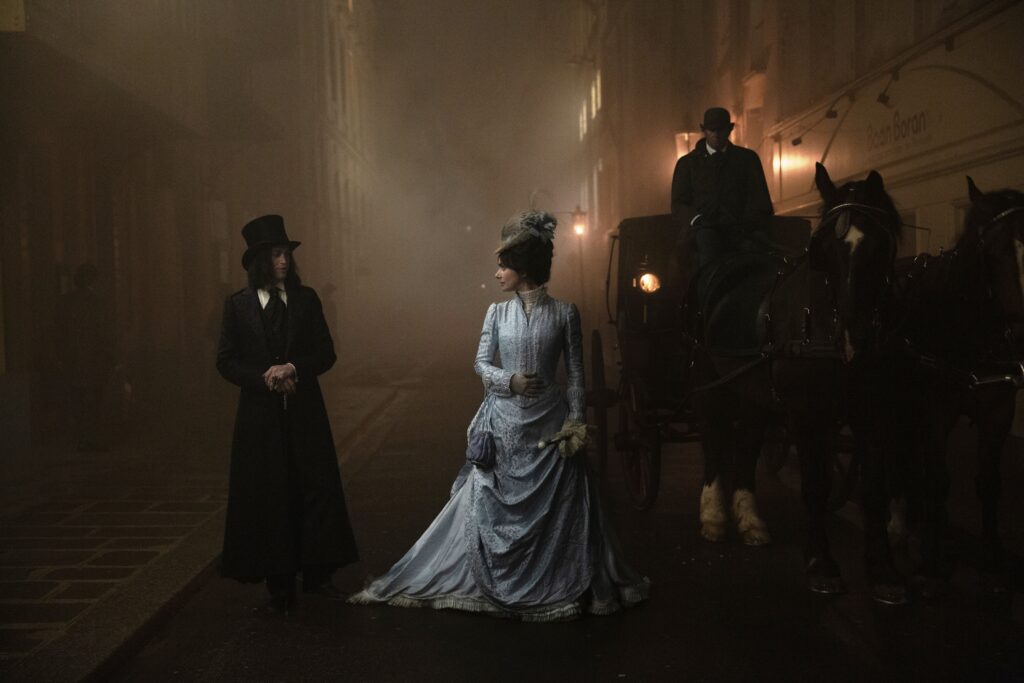
Jones’ portrayal of both Vlad and Dracula… electric. There is something about the sincerity in his eyes that brings a new spirit to our most famous undead. There is a moment after he finds Mina and she does something that warrants an apology, and she gives it. Before the words fully escape her lips, he utters “you are forgiven”. The way he looks upon her as if he’s saving her life finally and she is saving his is in itself worth the watch.
In that moment, all the narrative questions are understood: what happens when one tells God instead of praying to Him; who has the right to dictate how another responds to loss; and which is more important– what you want with them versus what is best for them.
Ultimately, Dracula: A Love Tale is a treatise on the multifacets of a charmed life: the fantasy of love, the mystery of love and then the travesty of it.
How awful things must be to even require sacrifice.
The film refuses to explain the supernatural. Everyone accepts it. No character needs convincing that vampires are real. The story is free to explore meaning instead of mechanics.
Many will reject it. It is the kind of movie where the filmmakers use story to show what they want to say instead of partnering with story to reveal ideas. The action takes a backseat to themes. There’s a subtle difference in the approach but it is there.
At two hours and nine minutes, it moves quickly. Whether because it glosses over complexity or because it wastes no time is unclear. What remains is a love tale driven by appetite: what people will do, become, destroy, worship, deny– just to keep from losing what they were never built to survive without.