
🍿 Popcorn: Sound, Sea & The Long Way Home
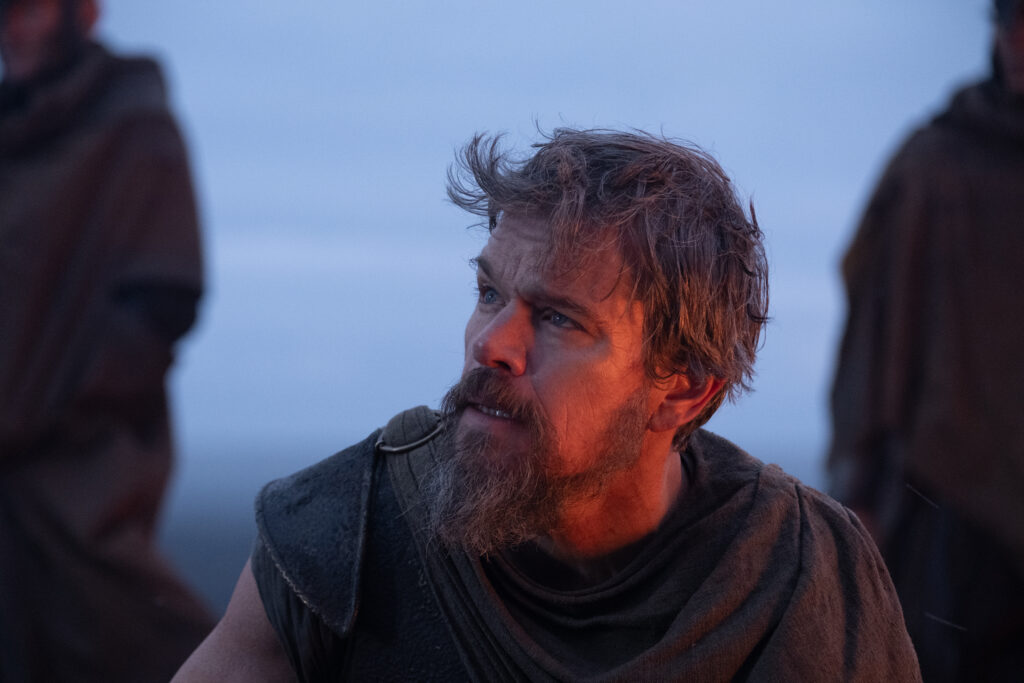
A rumbling crack of thunder. A cane booming against an echoing floor to command the attention of a debaucherous crowd. Waves explode over an unconscious Odysseus (Matt Damon). Sprawled upon the sand and shores is the king who has spent twenty years trying to find his way home. Christopher Nolan’s The Odyssey announces itself before it ever shows us a face.
Home, however, has not waited patiently.
Penelope (Anne Hathaway) is surrounded by men eager to replace her husband– to inherit both his throne and his wife. Their son, Telemachus (Tom Holland), is heir to the Ithacan kingdom in name only. Small in stature and even smaller in confidence, he offers little resistance to the growing mob of entitled suitors consuming his family’s wealth while awaiting permission to pluck and claim the flower of its crown jewel.
But rumors of godless raiders pillaging neighboring kingdoms eventually force Penelope to consider what she has resisted. Ithaca needs an army. A husband may become a military necessity even if he is not a romantic one. And the conniving Antinous (Robert Pattinson) is the frontrunner for her hand. Time’s race becomes a trek for the honorable to reclaim the throne before it is lost to tyranny forever.
What on first blush appears to be an adaptation of the classical epic into a muddied contemporary treatise on anti-patriotism and post-war psychological decay, after days of processing reveals itself to actually be a remarkable, soul-rendering ode to the power of epiphany.
The Odyssey appears to be about a king trying to remember his way home. In the tradition of films like Berry Gordy’s The Last Dragon, Kung Fu Hustle and The Matrix, The Odyssey’s destination is not external mountain summiting, but the holistic release granted by acceptance-induced enlightenment.
Nolan has not merely adapted Homer’s epic. He’s repurposed it. Where Homer begins with a hero trying to reclaim faith and home, Nolan begins with a celebrated soldier who must again become worthy of them. Homer is concerned with the inner spirit. Nolan is concerned with the mind.
Odysseus’s voyage across the sea is the visible journey, but just beneath runs another: processing a man into a hero.
The end of the film is, astonishingly, the beginning of the hero’s journey.
🛡️ The Matrix Beneath the Myth
On First Blush
For a mythology as rich as Homer’s, The Odyssey takes an awfully long time getting to the mythical. For anyone raised on the peplum adventures of Jason and the Argonauts, Clash of the Titans or the Steve Reeves era of sword-and-sandal spectacles, the monsters are the goods. Here, they’re an afterthought.
And still, Cyclops is worth the wait. His sequence becomes the greatest pro-vegan advertisement ever filmed. Rather than taking one sheep and moving on, Odysseus and his men greedily follow that sheep in pursuit of the entire herd straight into the pantry of a man-eating giant.
Congratulations.
You’re the livestock now.
Eat your vegetables next time.
Because the movie is so invested in Odysseus’ psychological environment, Circe’s island provides the only visceral stretch. Samantha Morton plays the isolated sorceress with equal measures heartbreak and terror, making her less villain than wounded guardian. What she does to Odysseus’ men is bonkers bananas in exactly the way Greek mythology intended.
The Trojan Horse receives one quietly brilliant reinterpretation. History celebrates the strategy. Nolan reminds us of the conditions. Those soldiers were packed inside that hot-ass wooden horse atop one another, trapped in the filth of each other’s pee and poop, enduring inspection after sharp inspection while hoping no one discovered the deception.
Yet for all its spectacle, the film somehow feels… small.
Ships travel from island to island, but rarely does the audience experience the voyage itself. The journey becomes a series of mythological pit stops rather than a lived passage across an unforgiving sea. The result is an epic that often feels curiously contained.
By removing much of the journey, Nolan also weakens the beautiful mirror Homer creates between husband and wife. Odysseus is imprisoned by the sea, Penelope by a sea of unwanted suitors.
After Processing
The longer The Odyssey settles, the less it resembles Homer. Instead, another film keeps surfacing. The Matrix. At first, the comparison feels absurd. One is a Bronze Age epic. The other, a contemporary sci-fi landmark. But it functions as a decoder ring that reveals the dramatic structure Nolan has hidden inside The Odyssey.
The grandeur of the sea and of Poseidon’s wrath is all but removed. The physical voyage is not the point. The internal one is.
Where Homer’s interior was about a return to faithfulness, Nolan’s is about a return to sanity. But not the kind of sanity found in opposition to a psychological break. The kind that occurs during the process of putting down narcotics and awakening to the real world.
The sea must be backburnered so that retrospect, the chief narrative tool allowing the viewer’s awakening to mirror Odysseus’, can work its magic on the mind.
The retrospective structure repositions what at first blush appears only a movie about PTSD and gradually reveals that the journey is not a diagnosis of psychological ailment nor is it carrying its hero toward mental stability. It is carrying him toward consciousness.
Everything outside of it is fabrication: the careful construction of a system that narcotizes its subjects through the pursuit of happiness, including concentrated power.
Piece by piece, certainty gives way to something far more unsettling than the traumas of man against war: the world as it is understood, is not the world as it truly is.
And like Neo in The Matrix, it becomes abundantly clear that Odysseus lives in a dream world, a simulation to mask the truth: that their bodies are free to roam but their minds are enslaved.
Everyone is, at any time, an agent.
The simulation isn’t a place; it is the conquering political construct and the people whose perceptions have been colonized by it. The danger isn’t war at all but warmongers.
By updating Homer’s voyage, Nolan transforms it into something resembling Neo’s awakening. The hero’s greatest battle is no longer against what stands before him, but against the assumptions that have governed him.
The sea becomes secondary.
Consciousness becomes the landscape.
Retrospect becomes the red pill.
And Nolan’s The Odyssey becomes the moments after choosing it and before waking up in the desert of the real.
🔥 Pyres: The Birth of a Hero
On First Blush
Theme is the wisdom of the storyteller that is stated. Premise is the wisdom of the storyteller that is demonstrated.
The demonstrated wisdom of Nolan’s adaptation is one of militaristic and psychological collapse. The notion that redemption is obtained by traveling inward. While the stated wisdom remains Homer’s– a classical truth that redemption is upward and in the will of the gods.
These two wisdoms spend nearly three hours wrestling one another.
The relationship between theme and premise in a well-constructed narrative is unity. The Odyssey fractures them. Into a confusing stew of what used to be there, what is newly there and where they converge or diverge.
Nolan repeatedly shows us a story about war, empire, societal decay and humanity standing alone after abandoning the gods. Homer discussed a man whose salvation depends upon returning not simply to his kingdom but to faith, love, covenant and home.
The original poem has always been about more than monsters. Odysseus’ journey is one of spiritual restoration. His arrogance separates him from divine order. His suffering teaches him dependence. Athena ultimately fights at his side because he has finally returned to the virtues he abandoned.
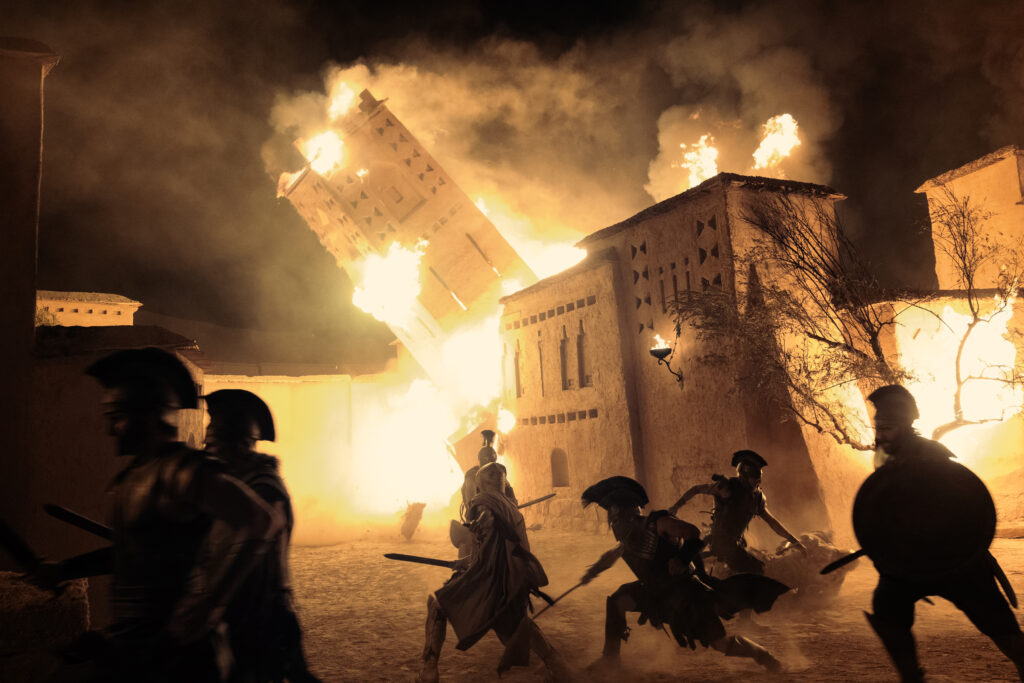
Shadows of Homer’s thread still exist. The thrill of heroic violence, redeeming a nation. Nolan simply never pulls it. Instead, he makes monsters of nearly everyone. Much more mythological in its violence, Ithaca and everywhere she touches through her soldiers are redefined by monstrosity. The will of man is more colossal than the size of any legendary beast.
After Processing
Confusion was never the point. Nor was it the problem.
Confusion is the mechanism by which the viewer is placed within the journey. It is the sensation required to connect wholly with the consciousness of Odysseus. It is the starting point of awakening. It is not clean, nor clear.
It is confusing. To lose memory of self, of contribution, and of mission.
Retrospect is the mighty, and risky, tool for placing a hand on you during the period of confusion and shaking you awake.
Retrospect unveils the functionality of memory-loss and remembrance in the narrative. It holds the lie and the truth together. It reveals the wisdom within the wisdom.
By utilizing retrospect, the audience undergoes the same conversion as Odysseus. We accept one version of reality because the film conditions us to accept it. Then Nolan quietly removes the condition that made our certainty possible. The movie does not change.
Our minds do.
What first appears to be an anti-war or anti-patriotism parable reveals itself to be an alarm clock set within the context of war and blind allegiance. A noble and contemporary supposition is the one where the hero subjects himself to a beloved institution of valor only to find it to be the conquering brute.
The political and military machine is the context.
Nolan’s concern is the mind.
And with it, the movie becomes a film. The film becomes an embrace to the initiated and an invitation to those who slumber. It is a forceful, urgent and lodestarring invitation to wake the fuck up.
🍷 The Trick of Retrospect
On First Blush
Odysseus is a soldier who, as time marches forward, finds himself more and more isolated. Could it be his brutish approach? That’s certainly how it seems. On first blush.
Odysseus ain’t the one. He’s infuriatingly cocky. Pigheaded. Impossible to talk to. Time and again, his men have the right idea. Take the sheep. Take the cheese. Get back on the boat. Odysseus? He wants to stay. He wants to meet the owner. He wants to play honored guest.
STOP. LISTENING. TO. HIM.
The Cyclops sequence crystalizes everything that feels wrong about him. Every instinct screams that his arrogance is about to get everybody killed. Odysseus cannot resist his own bravado. He taunts Cyclops, turning a miracle into a massacre. This isn’t a hero. It’s a man so enamored with his own judgment that everyone around him has to pay the price.
After Processing
Nolan uses his trademark time fractures, memory within memory and elliptical storytelling to conceal a remarkably simple argument: to be awakened is to be alone.
Retrospect is also the film’s greatest sleight of hand. First we stand with his crew. We judge him exactly as they do and share their mounting frustrations.
Calypso (Charlize Theron) appears less as captor and more as mentor. She functions like Morpheus, transitioning Odysseus’ mind away from what he knew to what is actual. She is offering the red pill, or the lotus that once operated as a sedative but now is a part of the awakening process. She is the training that shifts Odysseus’ mind.
Only after the reframe does the voyage reveal that while we were busy judging Odysseus, he was already being called.
Painfully.
Gradually.
Summoned to awaken. The gods are forcing him toward an awareness his men refuse. He tries to warn them. Reason with them. Maneuver them. Save them. But awakening cannot be borrowed, and faith cannot be outsourced.
Isolation is to be expected in the process of transforming from man to hero. To share the good news, only to be ridiculed for it.
His crew never contemplates surrender to the gods. From island to island and then finally on Helios’ shores, they remain aggressively
committed to appetite, comfort, possession and immediate gratification. Their total lack of faith equivalizes them first with The Matrix’s Lady in Red and then later, Cypher.
A betrayal of gods and hero.
Viewed this way, Odysseus doesn’t simply fail his men. He loses them one by one, mythological pit stop by pit stop not because of his arrogance but because when offered a hand out of the pit, they slap the gods’ hands away.
👑 The Kingdom of Agamemnon
On First Blush
Real leaps are made in Nolan’s hands. The audience does not start aligned with Odysseus. The viewer is asked not to identify with the protagonist, as stories usually do, but to stand united with the Cephallenians.
We are the patriots. We believe so blindly in our own power that we offend and deny the gods. Even as decay erupts all around us, we cling to our certainty, convinced of our own righteous hegemony.
Odysseus starts as that man. He only begins listening to his comrades after most of them have died.
Instead of following that dynamic all the way down, a larger force of militaristic arrogance overshadows Odysseus. Agamemnon (Ben Safdie) is such an overwhelming tyrant that Odysseus begins to feel less like a man making disastrous choices and more like another casualty of an already broken military machine. Agency quietly gives way to circumstance. In the process, what Odysseus stands for is diminished.
After Processing
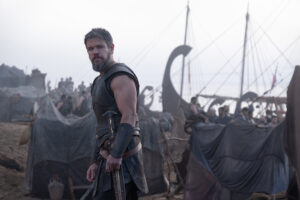
And yet, Agamemnon is not simply a tyrant. He is the system. He is the machine. He is the visual manifestation of a dark, concentrated political power that thirsts for dominion so deeply it draws enough energy in to continuously pillage and burn. Like The Matrix, the film is less interested in power itself than in how concentrated power subjugates the people enraptured by it.
Structural power manufactures a reality in which conquest is mistaken for virtue, domination for order, and endless expansion for destiny. Those caught inside it mistake obedience for conviction. Their lives fuel a machine that continually demands more kingdoms, more sacrifice and more bodies.
We are compelled to look at authority as a simulation. To study the effects of excessive pools of power concentrated in a few faceless hands and what becomes of the masses who participate in it.
The majority is benumbed, sedated, trapped inside the simulation like pod people, strictly so their vitality can be siphoned by the machine. A few inherit the machine and even fewer wake up from it.
Viewed this way, the Cephallenians are no longer soldiers. They are savagely active participants, lulled by power’s illusions, convinced they are acting freely while submitting themselves to a system that extracts lifeforce from them.
Faith in the gods could separate them from this masticating monster but they’ve committed full belief, not in the gods, nor in truth, but in the mythology of empire itself.
That is why Odysseus’ awakening must be co-experienced. He is not merely awakening from war. He is awakening from the universal reality Agamemnon represents.
⚖️ Compare: The Same Sea But Not The Same Ship
On First Blush
Christopher Nolan’s The Odyssey and Homer’s The Odyssey share characters, locations and many of the same narrative touchpoints. However, they are not traveling to the same destination.
The original poem assumes the world possesses an underlying moral order. The gods are real. Home is real. Ithaca is worth saving because it exists within that order. Odysseus’ long voyage restores him to it.
Nolan preserves Homer’s architecture while quietly replacing its foundation. His The Odyssey functions less like Homer’s poem and more like a smackdown for individual and societal self-righteousness. It asserts that the gods may be dead, so the only way home is to become thoroughly chastened.
After Processing
And yet, a closer inspection of the sea reveals that both versions of The Odyssey navigate it. They are headed to the same destination, just not on the same ship—and the sea itself is stratified into vastly different depths.
The destination for both is love.
In Nolan’s hands, Penelope is no longer simply the faithful wife awaiting her husband’s return. She is his confessional. As Odysseus recounts the voyage, she receives it from behind a scrim.
The warrior who crossed seas, defied monsters and challenged gods returns, not to boast of conquest, but to confess it. He’s brought his profound shame directly to the feet of love to be cleansed, to be received, to be raised from the floor.
Though he and his men were theicidal maniacs, Penelope is the place where Athena’s wisdom still lives, where faithfulness is apparent, where he might be absolved.
The victories. The failures. The lives lost. The man who left Ithaca is not the man who arrives. Nor is the man recounting the voyage the same man who lived it. The retelling itself is the final piece triggering his awakening.
✨Missed Opportunities
On First Blush
The most beautiful story in this adaptation isn’t the anti-patriotism parable Nolan insists upon, but the quieter one lying just beneath: the reunion of the feminine and masculine.
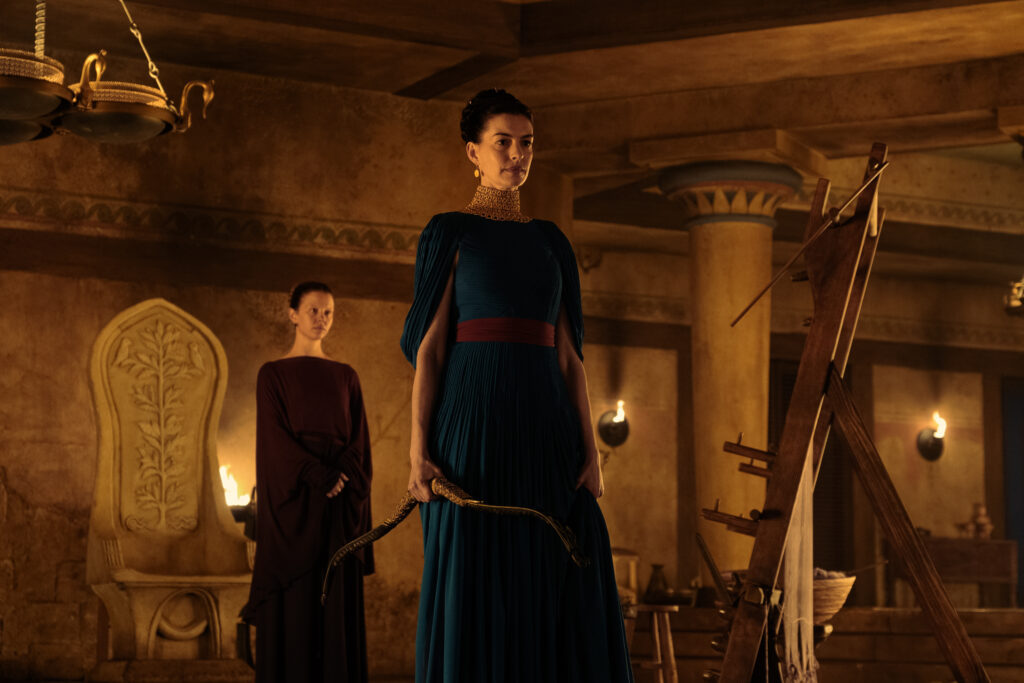
Penelope holds home in her hands. Reduced to little more than a maid in waiting, she preserves her station and stands her ground with the loom at her fingertips.
The warp and the weft.
To weave is to intertwine. To connect. To restore what has been made apart. For years, that loom protects her from the expectant suitors because it embodies strategy and precision. Faith. Endurance.
Circe stands as a stark contrast to that hope. She is what becomes of the mythic feminine when it can no longer trust the masculine. When it fears it. When it must constantly defend itself against it.
After Processing
Nolan argues that awakening is the prerequisite to true heroism, and here, it cannot be solidified without union with our divine other.
Just as the divine architect of creation split the masculine and feminine to create helpmates for tending the world, man’s powers multiply when these forces are reunited. This is the exact reason for Trinity’s presence in The Matrix. She does not exist for standard Hollywood romance; she is the absolute condition of structural completion that allows Neo to become The One.
Penelope operates on this same axis. She isn’t merely what Odysseus comes home to; she is his completion. The place where memory becomes truth. Where guilt meets grace. Where a fractured man is woven back together.
Into the one.
🍿🔥 Popcorn + Pyres Judgment
Christopher Nolan’s The Odyssey is not a film that ends when the credits roll. It begins.
Like Odysseus, the audience leaves believing it has completed the voyage, only to discover that the real journey starts now. After days of processing, the movie becomes an arresting, awestriking revelation.
The voyage is not asking us to admire or even judge Odysseus. It is asking us to awaken at his side. To awaken from the narcotic pull of power. It is not a heady thing in the end. It is soul. Nolan has made a film about awakening disguised as a movie about remembering.
The Odyssey is an acknowledgment of how difficult it is to wake when others actively choose sedation. It is every meaningful encouragement: Mufasa’s “Remember who you are”, the Na’vi “I see you”, and Samwise’s “But in the end, it’s only a passing thing, this shadow. Even darkness must pass. A new day will come.”
It stands as a radiant, peace-bringing embrace to those who have already had their world shrink for waking to an uncomfortable truth. It is every single saying that has ever brightened your mind, whispering directly to your heart: you are not alone.
It is a comfort to the Neos of the world who know the isolation, anger, and heart-hardening reality of being awake in a world of the fake. It lets them know they are seen, cared for, and are not in the dark.
And for those still asleep, it stands as an invitation to the light.
Because The Matrix’s end represented Neo’s beginning, we naturally yearned for sequels. We will neither need nor want a sequel for The Odyssey. Its resolution is a singular, complete, and spiritual redress.
Neo awakens. Thomas Anderson dies. Bruce Leroy glows. Leroy Green vanishes. The Buddhist Palm butterflies. Sing cocoons.
Odysseus remembers, or, awakens. The conqueror perishes. Only then does he become the hero history insisted he already was.
Odysseus brings the unbearable weight of memory to the feet of love, where truth may finally be spoken and shame may finally be laid down. Once the system-built consciousness collapses, nothing is left but the raw, liberated mind… and love.
Love is the horizon.
Everything else is death.