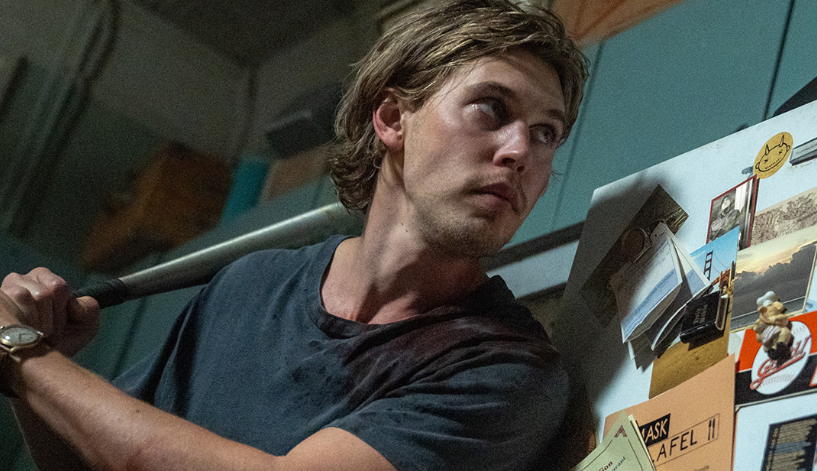

“If you can’t bite, don’t show your teeth.” —Carol Kane as Bubbe, Caught Stealing
There’s a world of wisdom in that one line. It should’ve been the guiding ethos for this entire movie. Director Darren Aronofsky (and maybe writer Charlie Huston too) seems so enamored with the chaos, the carnage, the coolness of crime that he forgot the most essential part of a caper: the bite.
Not the bark. Not the post-chomp bloat, which it has in spades. The bite.
Popcorn: The Surface Pleasures
Grunge graphics and a pulsing needle on the record. We get blood, booze and 1998 NYC back-alley shadow. Scuffed to the edge of the era’s schmutz and glamor—pay phones, answering machines, low-slung, bunched at the ankles jeans, and most importantly, a youngster’s mood. Oh, what a stylish grime bath.
Hank (Austin Butler) was supposed to be somebody. Once upon a dream. A former baseball golden boy turned bartender who’s more beer-guzzles than bat-swings. He’s got a girlfriend and an existential hang-up about his glory days. When his neighbor bolts for London and asks him to cat-sit, Hank says yes. One errand later, he’s in a world of hurt, pursued by crooks and cops, and surrounded by corpses.
And this should be a wanton, welcoming smile, but Caught Stealing’s got too many teeth on display and not enough sex appeal to keep it from being a grinning creepfest.
And yet, I can’t stop thinking about it.
Pyres: The Fire Beneath
Aronofsky drops us into a New York that’s supposed to feel analog. The best it achieves is a stage-set where the props department was ready, but no one really gave a damn. That might be okay. There are no candy-colored nostalgia cues here. No rose-tinted halogen glow.
Perfect for his signature. The spiral: a character under siege, reality bending, the camera suffocating. He’s done it with addiction, obsession, art. Here, he applies it to crime. With this film, he wants to hurt you– not break your heart, just bludgeon your brain.
Sadly, the glorified gross-me-outness—vomit, blood, catshit, offbeat bodily harm– forgets to be metaphor and just becomes mess. Caught Stealing tries to cause pressure, but it just wiggles in material and experiential clutter.
Even still, it keeps smorgsbording in my mind.
Character KOs & Misfires
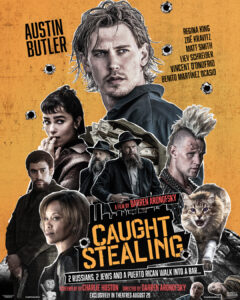 The cast is stacked, no doubt. And they all show up swinging.
Carol Kane is sharp and grounded, her Bubbe a streetwise oracle with the film’s best line. But the MVP? Regina King.
As NYC Narcotics Detective Roman, King is pressurized, electric, striking. She shows up and almost pulls us back from the edge of dissatisfaction. Her presence hums with authority and even though her arc feels inevitable, that predictability is weaponized. It reminds us: this city, this system, this story don’t care what you hope for.
As for the rest—Zoë Kravitz, Matt Smith, Liev Schreiber, Vincent D’Onofrio, Griffin Dunne, Bad Bunny—they’re all varying degrees of bangfully necessary but woefully wasted.
And then there’s the cat. The best of them. Not just a plot device, not quite a pet. A motif. It keeps him grounded in humanity, sure, but this little furball is more. He’s Hank’s mirror. Both are wide-eyed, soft-bodied and seemingly docile until they bite. It’s the catalyst (wink, wink) for every danger that follows, but it’s also the reflection of Hank’s potential: lovable but compounding into an underestimated threat.
The real tragedy is that the cat’s got more edge than the movie while Hank eventually bares his teeth, the film itself never truly does.
The Big Letdown
A caper doesn’t need to be cheerful. But it does need charm, tension, or at the very least, payoff. Here, Aronofsky gives us a crucible with what appears to be no catharsis. The endless escalation of the world playing upon Hank without any self-defense turns the audience into hostages.
Then there’s the romance. Butler and Kravitz have all the chemistry of a root canal. Their love scene? Over-sexualized and clinically detached. A surgical sermon on how to miss the point of intimacy. Aronofsky directs sex like he’s holding a precision tool, not a pulse. It’s all incisions, no instinct.
It’s grossly gratuitous, overdone. But that’s the point. Hank doesn’t know how to be in a body anymore. The scene isn’t about pleasure. It’s about proximity to meaning. It’s about the tragedy of intimacy becoming just another thing Hank stumbles through. Zoë Kravitz, ever luminous, is presented not just as an object, but specifically a barometer: she reflects just how fevered his life has become.
This isn’t eroticism. It’s elevated existentialism with its shirt off.
That doesn’t mean we should let him straddle us with this mockery. Making Zoë Kravitz’s character a beautiful cipher, whose body is lingered on more than her inner life, may be deliberate—but deliberate isn’t the same as defensible.
This treatment doesn’t just feel outdated, it feels disrespectful even when set in the era it harkens back to. It’s cinematic backsliding dressed up as grit. Sidelining the woman, overexposing her body and reducing her to a support beam for a man’s transformation is not rebellion. It’s relapse.
The Crucible: What It Means to Burn
Caught Stealing fails as a caper, but not as a confession. It doesn’t crackle with cleverness—it seethes with the slow boil of someone remembering they once had canines. Though dissatisfying for its story type, this is its saving grace.
For anyone who’s had their glory days stolen, whose hands forgot their swing, who’s been buried under the weight of lost inner power, this movie isn’t entertainment. It’s presentiment.
When Hank gets knocked down and pisses blood, when he signs off with his mama, when he grips the bat again—it’s not about plot. It’s about proof. That the squeezing armor that was meant to protect but subsequently served as his personal cage, didn’t kill him. He can still conjure. He can still hit back.
So no, Caught Stealing ain’t playing the same game as your typical heist caper. It’s not here for cool or moral payoff. This isn’t Ocean’s Eleven or Snatch. It’s closer to Dunne’s After Hours but with gnawing and Butler’s baseball bat. This is the story of a man being broken open by absurd, unrelenting violence, and finding something ferocious inside himself.
It doesn’t go down easy. But if you’ve ever been in the crucible yourself, it might just feel like knowing.
Popcorn + Pyres Judgment
There’s something magnetic in watching Hank go from butter-soft bartender to bloodstained brawler. You could think Aronofsky’s signature cruelty is rooted in sadism. It’s not, it’s about endurance. He likes watching people get simmered down to bone and sinew just to see what’s left.
It’s not pretty. But it is honest. Hank isn’t all hero. He’s a vessel. And what seeps through him is everything he gulped down instead of becoming: agency, instinct, rage. Aronofsky’s cruelty isn’t for spectacle. It’s to ask, what happens when a man who’s forgotten how to swing remembers his fight?
A powerful, impeccable inquiry.
Yet still, the reduction process gets soppy. There’s only suffering. And even when there’s a delicious way to make it work, Aronofsky forgets the one key ingredient: relief. Even shadowplay needs light to remain tasteful. In the end, Bubbe’s warning is the ultimate truth. Audience cooked. Aronofsky no eat.