
Light spoilers ahead…
“God’s garden is full of weeds.” —Ben Wang as Hank, The Long Walk
Popcorn: The Surface Pleasures
The film opens on an acceptance letter, its words covering the screen like a decree, military in tone, mythic in implication. To transform hardship into hope— that is the goal of The Long Walk. A national tradition in dystopian collapse, cloaked in patriotic rhetoric and crowd frenzy. It’s a televised purge of boyhood and mercy. Touted as a path to riches and maybe relevance.
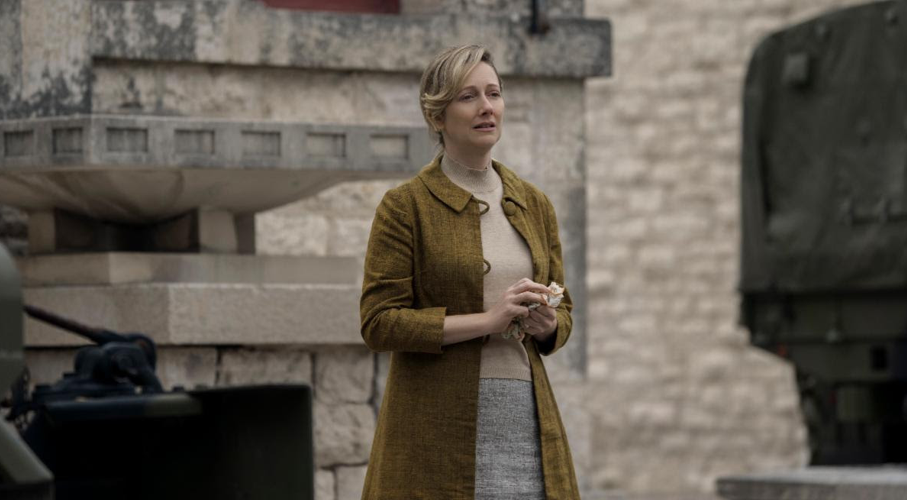
When Raymond Garraty (Cooper Hoffman) arrives at the starting line with his mother Ginnie (Judy Greer), the camera holds. She reveals the emotional stakes from the tippy top as she begs him not to go. But like most boys on the brink of manhood, his mind is made up.
In a huddle on the ground before them sit the other boys most likely destined to die. They mingle, posture, assess and even connect.
And then The Major arrives. The man– a myth, propped up by the people, a beast of pageantry, menace and manifest destiny. Mark Hamill plays him not with bluster, but with the cool tyranny of someone who knows the game is rigged and always will be.
Rules of engagement: walk faster than three miles per hour or get a warning. Get three warnings and you’re executed on the spot. There is no finish line. Walk until there’s only one left and get your wish.
The question isn’t who will win.
The question is, how far can they, or are they willing to, go?
Go.
Bang.
A gunshot. The walk begins. It is a trek not measured in time but in distance. Through rot, pain and depletion, we cannot turn away.
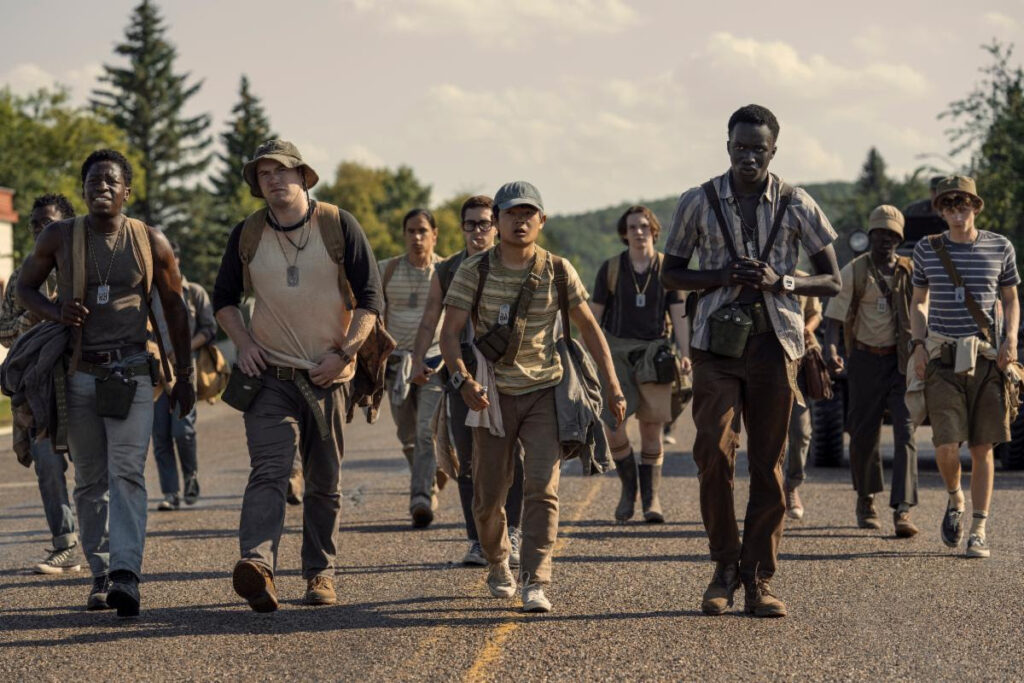
It is difficult to watch. Graphic. Stark. Revolting. Director Francis Lawrence (of The Hunger Games) knows how to stage a spectacle where revelatory violence illuminates deep spiritual and psychological suffering. That craft is intact here. But unlike his previous YA work, this isn’t varnished to a gleam. It’s unpolished punishment as proclamation.
At its most disturbing, a boy struggles to maintain speed. His pants drop. His bare body exposed, he defecates mid-stride, shit squirting from his ass onto the pavement. He is shot in the head. The camera does not flinch. And that is the thesis of this film. The viewer is subjected. There is no retreat.
So the deepest question is, if they make it that far, who or what will they be at Mile 59, Mile 209, Mile 326?
Pyres: The Fire Beneath
How to keep a movie about walking compelling beyond the foreboding and mystery of its premise?
The Long Walk is sacrament as contest. It’s about watching children—young adults, teens, babies for all intents and purposes—deteriorate step by step into their own blood-choked finale. The last things they ever do, ever say, ever feel. We watch their final rites.
This is not a film that moralizes. It depicts. It reflects. It reveals. And it shows everything. What the body becomes when it is at war and at war with nature, both mother and human.
JT Mollner’s adaptation of Stephen King’s novel is faithful in tone and tension. Glum. Blue. Desolate. The visual violence is stark, graphic, unflinching. That is what makes it visceral. The boys begin wide-eyed and hopeful. Then come the stages: homesick and scared, worn and weary, and eventually, dead. All but one. This psychological violence is what makes the film linger.
And yet, here? Survival is suspect.
What is prosperity when it sits atop a mound of corpses? What do we root for? Who? Is this what it means to be lucky? To lose what comes in the shape of life– dreams, friendships, a willfulness to go on.
The Great Sacrifice
The performances are exceptional. Judy Greer tugs tears from the center of the viewer turned immersed spectator in her first moments onscreen. She gifts us a mother already in mourning. Ben Wang’s Hank is the comic relief, but he’s never played for cheapness. Arthur (Tut Nyuot) is the sweetness of belief. Collie (Joshua Odjick) carries silence and rage like a blade.
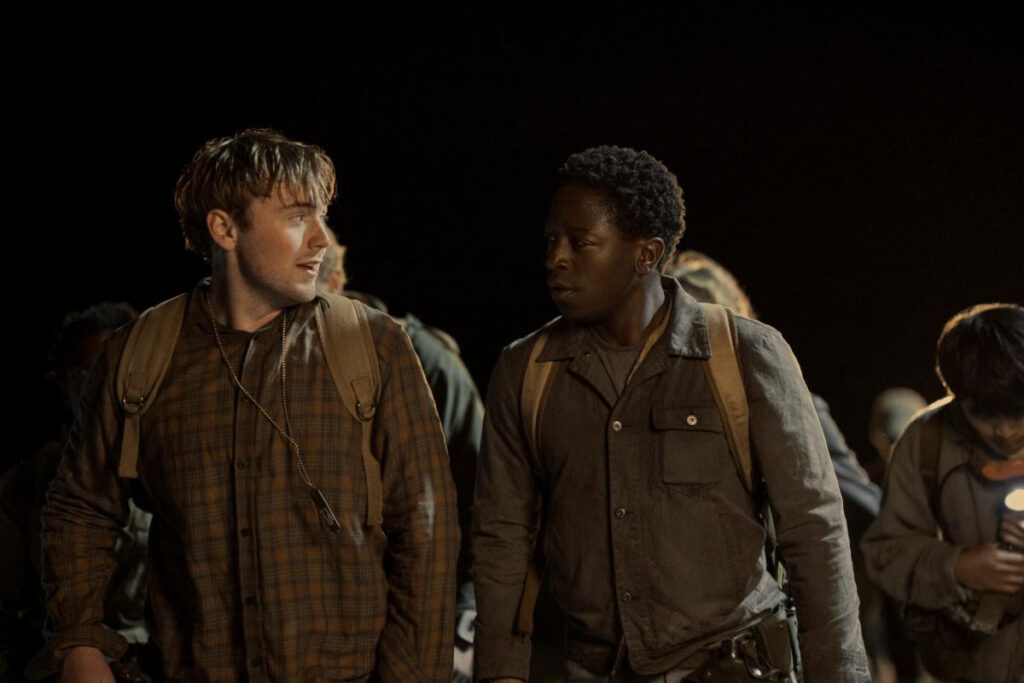
But this film belongs to two: Raymond and Peter McVries.
The great rising star, David Jonsson, delivers an elegant performance of torment as Pete. He’s verbal, but precise in his being an avatar for who a hope-filled man is transformed into by each mile marker.
If Pete becomes a portrait of what we give, Ray becomes the ledger of what we refuse to forgive.
By contrast, Ray’s resolute motivations unfold onscreen. His arc is illustrated through flashback, which may be weaker than what could have been imagined in the mind but potent for continuing to root for him.
The narrative uses them as anchors. There’s a technical structure to this: inner circle (Ray and Pete), middle circle (boys with arcs), outer rings (boys with none). When other characters’ backstories emerge, they move up the line to converse with Pete and Ray. When someone is about to die, they’ve usually fallen way behind, outside the reach of this core duo—a smart, layered approach to story staging.
Together, Pete and Ray form the axis of the film’s Garden of Gethsemane-sized inquiry: do we hold our fellow travelers up, even if it leads to our own demise?
And that’s the truth of this story. It’s not about death. It’s about how we are along the road to death. What’s left in the final moments when youth has been spent like currency and nothing remains but choice.
This isn’t stylized tragedy. This is what it looks like when systems break us open and call it service.
Popcorn & Pyres: The Judgment
The Long Walk is unrelenting. It’s punishing in a way that refuses to seduce the audience. It’s about suffering, not simply spectacle. Though the audience is transformed into captive spectators.
For folks who thrive on joy, sunshine and fantasy, this film might be too bruising a battleground.
But its honesty is bashing in the best way. This is not a movie about personal triumph. It’s about collective decay and the flickers of connection we grasp for even in the midst of institutional and interpersonal putrescence.
What The Long Walk asks is not can I win, but what is my true nature and what does it cost to be decent in indecent times?
One watch is most likely enough. But one is a must. Especially for anyone trying to hold on to their own goodness in challenging sociopolitical times and definitely for those still clinging to the illusion that the loss of compassion is a fair price for survival.
This is a film about watching mind and body fall away while preserving the one thing that can never be consumed by The Major— spirit.
Recommended—with caution, with reverence and with eyes wide open.